
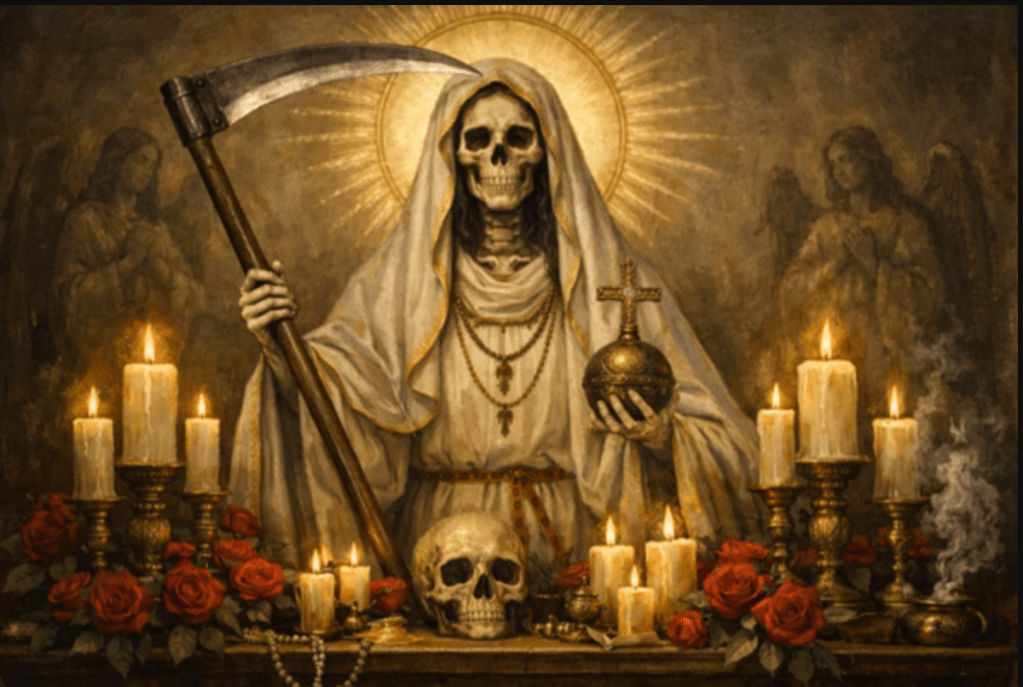
The death cult of Santa Muerte appears briefly in TV and movie cartel/crime stories, like AMC’s Breaking Bad and Better Call Saul, as a powerful, ambiguous figure related to death, protection, or dark forces. There are even darker programs, such as the 2022 film Santa Muerte or the Penny Dreadful: City of Angels series, where she’s a major character. Within film and TV, her portrayal varies, from a narco-saint aiding drug lords to a more neutral psychopomp guiding souls, reflecting her complex role in popular culture as a folk saint for the marginalized and dangerous. But why should we care? This is just entertainment, right?
Over the past 24 years, Santa Muerte has grown dramatically among migrants and marginalized communities (poor, LGBTQ+, and criminals) in the U.S. and Mexico, especially during crises like COVID-19. Shockingly, it is now one of the fastest-growing religions in the world, with the largest number of devotees having become devotees only since it went public in 2001. Social media has really been an important part of the globalization of her devotion. There are now devotees everywhere in Europe, Australia, the Philippines, and all over Latin America.1 In fact, people in the Ukraine and Poland are also interested in Santa Muerte, most likely as a means to combat the growing threat of Russia.2
As more people are embracing Santa Muerte, we are seeing more attacks against Immigration and Customs Enforcement. In this article, we examine the impact of Santa Muerte on U.S. immigration policy and what to expect if no action is taken now to combat the rise of Santa Muerte in the United States.
 rainbowapologetics.com