
Introduction
The current war against Iran raises the question of whether we are quickly approaching the War of Gog and Magog that is prophesied in Ezekiel 38. In the future, Gog will be the leader of a great army that attacks the land of Israel, which will be living in peace and without walls protecting themselves from invaders such as Hamas (Ez 38:11). A lot has to happen for Israel to feel secure enough to live without walls; however, the geopolitical stage is changing so fast today that it is hard to keep up with new developments.
It is not hard to imagine an Ezekiel 38 scenario developing in the near future; therefore, who is Gog and what is Magog, Meshech, and Tubal? According to Got Questions Ministries,
Most Bible commentators interpret “Magog” as Russia—and, indeed, Russia is straight north of Israel, all the way up to the Arctic Circle. According to this view, “Rosh” is a reference to Russia, “Meshek” is either Moscow or the people north of the Black Sea (the area of southern Russia and Ukraine), and “Tubal,” which is always listed with Meshek in Scripture, is identified as a city in Siberia or an area in central Turkey.[1]
But is this an accurate depiction of these invaders? Who is Rosh, and why do some translations of the Bible not mention this people group?
What is the Problem?
Did you know that within the word-for-word translations of the Bible, most translations say that Gog is the Prince of only Meshech and Tubal? Only the New American Standard Bible (NASB) says that Gog is also the Prince of Rosh. According to Tom Finley of Biola University,
The NASB stands virtually alone among English versions in including Rosh in verse three, a name that has sometimes been identified with Russia because of the sound similarity. The BDB Hebrew lexicon interprets Hebrew rō’sh in the passage as a geographical name, and the NASB based its translations mainly on that lexicon. All other versions, including the KJV and the NKJV, take rō’sh as part of the description of who Gog is—“the chief prince of Meshech and Tubal” (KJV). The recent Hebrew and Aramaic Lexicon of the Old Testament (HALOT) gives support for this interpretation. The ancient Greek (Septuagint) also transliterated the Hebrew term as a name (Ros), but the Latin Vulgate, the Syriac Peshitta, and the Aramaic Targum (Jonathan) all interpreted the word as part of the descriptor (chief) of Gog. Even if the Hebrew does imply the name of a country called Rosh, it is by no means certain that it has to represent modern Russia. Sometimes sound similarities can be accidental. (As an aside, the NASB also has Rosh in its translation of Isaiah 66:19, even though no Hebrew manuscript has anything that resembles rō’sh. While Rosh occurs as the name of one of the sons of Benjamin [Gen. 46:21] there is very little evidence that the term was ever used of a country in the Bible.)[2]
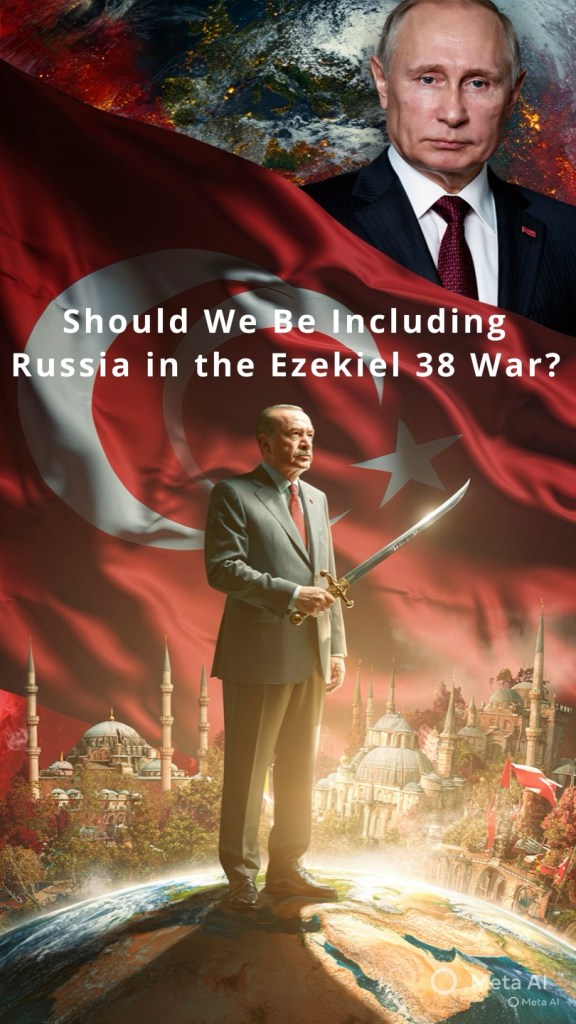
If Gog is not the Prince of Rosh, then how much should we be concerned with Russia regarding the future Ezekiel 38 war? Should we be focusing our attention on Turkey instead?
What This Means.
A Different Perspective on Persia
If Gog is not the Prince of Rosh, but only the Prince of Meshech and Tubal, this makes the coming fall of the Iranian regime especially interesting. With the Shia Iranian regime gone, hopefully their proxies (Hamas, Hezbollah, and the Houthis) will be gone too. Ezekiel 38 states that Persia (modern-day Iran) will be one of the major players in the Ezekiel War (Ez 38:5). But what is Persia? Did the ancient Persian Empire only include the land that is now called Iran, and how does this relate to Turkey?
Recep Tayyip Erdoğan, the President of Turkey, has openly stated he wants to recreate the Ottoman Empire and take back Jerusalem. According to Ruth Wasserman Lande, Erdogan’s strategy to “liberate” Jerusalem involves Ankara quietly rebuilding this empire and encircling Israel with its de facto occupation of Syria, its military footprint across Africa, and its persistent efforts to insert Turkish “social workers” into Gaza under the banner of humanitarian aid.[3]
Furthermore, Erdogan’s foreign minister, Harkan Fidan, has this image at the top of his X account page. It shows how Turkey wants to not only take over land possessed under the Ottoman Empire, but land possessed by the Persian Empire as well. Why is the Persian Empire included in Fidan’s graphic? Erdoğan has increasingly integrated Pan-Turkic ideology into Turkey’s foreign policy, merging it with neo-Ottomanism and Islamic solidarity to boost Ankara’s influence from the Caucasus to Central Asia. This larger Turkey could encompass Turkish-speaking people in the Russian region of Kazan (Tatarstan), Crimea, Ukraine, Azerbaijan, Central Asia, northern Iraq, and northwestern Iran. Could a Pan-Turkic alliance be the Meschech and Tubal, and Persia mentioned in Ezekiel 38? Could Gog be the future leader of this Pan-Turkic alliance?
A Prosperous Israel and an Isolated Russia
Before the Ezekiel War begins, Israel has to be prosperous for the nations to capture spoil and to seize plunder (Ez 38:12). Interestingly, Israel’s economy is highly developed, resilient, and technologically advanced, with a nominal GDP surpassing $580 billion in 2025 despite two years of war.[4] Furthermore, according to the Jerusalem Post,
Israel is “the region’s dominant economic force,” the only country in the world to have risen from a poverty-stricken developing country at its founding in 1948 to the ranks of just 40 developed economies as defined by the IMF and then be classified as a developed financial market.
Israel’s GDP per capita has nearly tripled since 2000 to more than $55,000, which is 70% of the US equivalent, while Saudi Arabia’s is a third of the US’s, roughly the same as 25 years ago.[5]
In addition, Israel has recently become an exporter rather than an importer of natural gas, thus reversing its relationship with Jordan and Egypt, making these countries dependent upon Israel for economic security.[6] Furthermore, by getting its gas from Israel, Egypt is able to save enough money to rebuild its infrastructure and become the primary natural gas supplier to Europe again. Europe is seeking a new supplier of natural gas to isolate Russia and stop the war in Ukraine. If Egypt is able to rebuild its infrastructure, the Israel-Egypt partnership will soon replace Russia as the primary energy supplier to Europe.[7]
In addition, according to Reuters, “Turkey could meet more than half of its gas needs by the end of 2028 by ramping up production and increasing U.S. imports, in a shift that threatens to shrink the last major European market for Russian and Iranian suppliers.”[8] A continuing war in Ukraine and the probable fall of the pro-Russian regime in Iran do seem to dampen the likelihood that Russia would be a major player in the Ezekiel War.
Conclusion
Some prophecy experts believe the Ezekiel War is one of the events leading up to the tribulation. While others think it will happen closer to the midpoint of the tribulation, since Israel will be living securely (Ez 38:11), possibly because of the seven-year covenant they will sign with the Antichrist (Daniel 9:27). While only God knows when all this will occur (Matt 24:36), the current geopolitical environment suggests that we should focus our attention more on Erdoğan’s Pan-Turkic ideology, neo-Ottomanism, and Islamic solidarity.
Erdoğan is continuing to play both sides by remaining in NATO and yet building alliances with Saudi Arabia (historically a rival country). Interestingly, Turkey appears to be building an Islamic NATO by merging its advanced defense technology capabilities (drones/navies) with Saudi Arabia’s financial resources, and Pakistan’s nuclear capabilities and large military.[9] This partnership is more concerning than Iran because both Turkey and Saudi Arabia are allies of the West. However, we also know from Ezekiel 38 and 39 that God will defeat Gog and his coalition of invaders; therefore, we as Christians have nothing to fear.
Authors
Stephanie Potts is the author of, Social Justice and the Deification of Man: What to Know When Talking with the Christian Left. She and her husband, Jim live in Dayton, Ohio, and have been married for 24 years. She worked with the federal government for 15 years as an intelligence analyst and then entered full-time Christian service in 2015. She first joined Haven Ministries in Denver, Colorado, in 2015 and then transferred to Midwest Christian Outreach, Inc in 2021. She earned her Bachelor’s degree in Political Science and International Relations from Florida State University and her Master’s degree in Geographic Information Systems from Penn State University. She is currently pursuing her master’s degree in Christian Apologetics at Southern Evangelical Seminary. She has special interests in indigenous religions – especially Native American spirituality – and in responding to Catholicism and the social justice movement.
John Haller, and his wife Pam, are co-founders of Fellowship Bible Chapel in Sunbury, Ohio, where he currently serves as an elder and teacher. Professionally, John has been an attorney for 46 years, focusing his practice on complex commercial and business litigation. John also served on the board of Grace College and Seminary for 25 years. He has B.A. from Grace College, and M.S. from Indiana State University, and a J.D. from Indiana University McKinney School of Law.
[1] GotQuestions.org. 2014. “Does the Bible Say Anything about Russia in Relation to the End Times? | GotQuestions.org.” GotQuestions.org. March 27, 2014. https://www.gotquestions.org/Russia-end-times.html.
[2] “Thoughts on Ezekiel 38.” 2012. The Good Book Blog – Biola University Blogs. April 4, 2012. https://www.biola.edu/blogs/good-book-blog/2012/thoughts-on-ezekiel-38.
[3] “Turkey Emerges as New Threat for Israel and the West | the Jerusalem Post.” 2025. The Jerusalem Post | JPost.com. December 16, 2025. https://www.jpost.com/jerusalem-report/article-879845.
[4] “Israel’s Strong Economy on the Path to $1 Trillion | the Jerusalem Post.” 2025. The Jerusalem Post | JPost.com. November 24, 2025. https://www.jpost.com/opinion/article-874836.
[5] “What’s next for Israel’s Economy after Two Years of War? | the Jerusalem Post.” 2025. The Jerusalem Post | JPost.com. November 6, 2025. https://www.jpost.com/jerusalem-report/article-872978.
[6] JNS TV. 2025. “MASSIVE Moves & Gas Discoveries Are Turning Israel into a Global Powerhouse.” YouTube. December 21, 2025. https://www.youtube.com/watch?v=Cq9Hhjq1BAM.
[7] Solomon, Ariel Ben. 2022. “Israel Hopes to Step in as Europe Looks for Alternatives to Russian Energy.” JNS.org. April 13, 2022. https://www.jns.org/israel-hopes-to-step-in-as-europe-looks-for-alternatives-to-russian-energy/.
[8] Sezer, Can. 2025. “Turkey’s Gas Shift Threatens Russia and Iran’s Last Big European Market.” Reuters, October 8, 2025. https://www.reuters.com/business/energy/turkeys-gas-shift-threatens-russia-irans-last-big-european-market-2025-10-08/.
[9] “Talk of a Turkish Military Alliance with Saudi Arabia and Pakistan Reflects Ankara’s Opportunistic ‘Hedging’ Strategy.” 2025. Chatham House – International Affairs Think Tank. September 23, 2025. https://www.chathamhouse.org/2026/01/talk-turkish-military-alliance-saudi-arabia-and-pakistan-reflects-ankaras-opportunistic.
 rainbowapologetics.com